Someone asked in the game chat last week why their settlement's grain kept running dry even though nobody was actively raiding. The honest answer took four paragraphs and touched three different systems, so here's the long version.
Why resources exist
Failed State doesn't have mana, stamina, or a generic "energy" bar. The game simulates your settlement asynchronously so it keeps running whether or not you're watching, and resources are the thing that actually paces the game.
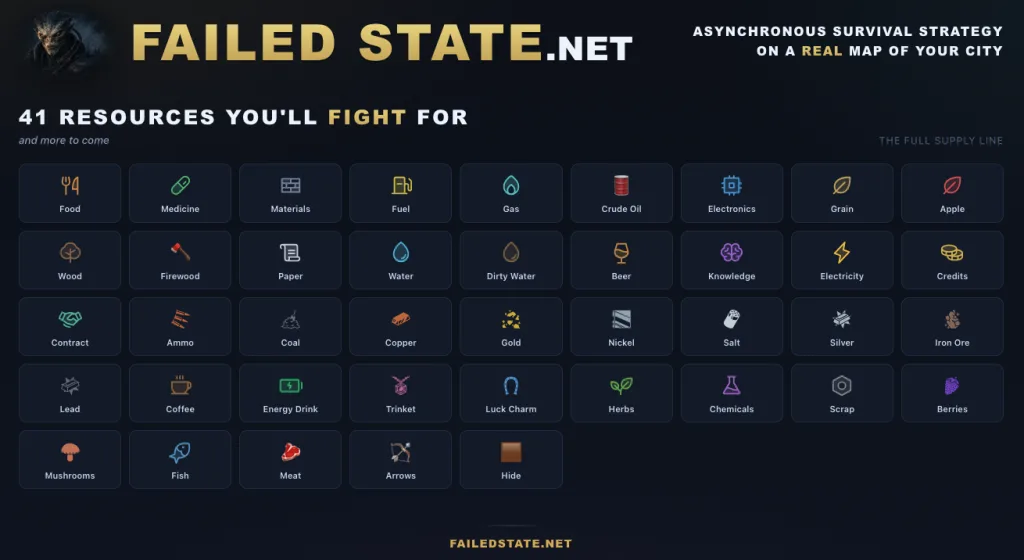
They decide what's waiting for you the next time you log in: a claim you can finally afford, a production line that stalled overnight, a settlement that grew or one that didn't. Right now there are 41 of them, and the bar we hold every single one to is the same: does this force a real tradeoff, or is it just decoration on a number?
They're not all the same shape, either. Some are single-purpose intermediates burned by exactly one recipe, some like water, credits, and materials are near-universal sinks that unrelated systems all draw from at once, and a few are pure faucets we haven't finished building a sink for yet.
From OpenStreetMap tag to supply line
Every building on your map started life as a raw tag in OpenStreetMap data. man_made=silo becomes a silo; landuse=farmland, orchard, vineyard, and greenhouse_horticulture all collapse into farmland.
A storage tank tagged content=oil or content=fuel becomes an oil tank farm, amenity=fuel becomes a gas station, and natural=wood or landuse=forest becomes forageable forest. It sounds tidy written out like that. It is not tidy to build.
Wiring in a single new building type touches roughly twenty files, and at least three of them fail silently: no compile error, no crash, the type just never spawns and you find out from a bug report three weeks later. We've shipped that exact mistake by forgetting to register a new type in the density and priority tables that decide what survives when a map cell is crowded.
We've also shipped the inverse bug: a new OSM tag family, historic for landmark buildings, got taught to the mapper but never added to the actual Overpass query that fetches data from OSM in the first place. The code was ready to place those buildings, but they never showed up on real maps because we'd literally never asked OpenStreetMap for them.
Real-world data is messy in its own right. Plenty of houses are tagged with nothing but bare building=yes, with the actual landuse=residential sitting on a different polygon around them, which meant our importer had to learn to look at neighboring context instead of just the building's own tags; one rural village tile imported a grand total of two buildings before we added that fallback.
How claimed locations produce
Once a location's claimed, it can run a production line. 47 different building types host 48 distinct recipes between them.
- Brewery. Grain + water becomes beer on a 150-second cycle.
- Research center. Electricity + water + materials becomes knowledge on the same cadence.
- Water-extraction site. Raw materials become water, with yield nerfed from 5 down to 3 per cycle so one lone water claim can't cover a whole settlement's demand.
- Grain silo. A finite local reserve is drawn down every cycle, and when that reserve is gone, it's gone until the world reseeds it.
Production isn't an infinite tap. It's a line that runs, a stockpile that depletes, and a choice about what to build next.
Where the resources go
Production is only half the loop. Your people are quietly spending everything you make, and per-survivor food and water upkeep charged every single tick is by a wide margin the largest resource sink in the entire game.
Water has the widest blast radius of any resource in the catalog: brewing, research, farming, cooking, and medicine all draw from the same pool. A water shortage doesn't break one system, it throttles five at once.
Storage isn't infinite either. Base capacity is 120, climbing to 140 at settlement level 5 and 180 at level 9, but overflow doesn't just evaporate: assign a Quartermaster and they'll auto-sell the excess at a discount instead of letting it spoil for nothing.
Running short on food or water doesn't just sting locally. It directly feeds the hardship score that, weighed against how attractive your settlement is, decides whether your population is growing or quietly shrinking while you're offline.
Failed State is in active development: asynchronous survival strategy on a real map of your own city. failedstate.net (https://failedstate.net/?ref=bmmorpg_devlog)
Comments